
By Corey Kim, MPT | Registered Physiotherapist & Tarra D’hoine, MPT | Registered Physiotherapist | Published December 9, 2025 [Updated June 23, 2026]

How do I know if it’s hip pain versus back pain?
Does this sound like you?
Hip pain and can barely walk
Hip pain to the knee
Hip pain with external rotation
Hip pain with running
Hip pain for months
Or maybe you're focused on the location of the pain. Many of my clients report:
Pain at the hip bone
Buttock pain
Groin pain
Pain in the front of the thigh
Pain in the inner thigh
What is a hip?
The hip is a ball and socket joint that has ligaments and muscles that wrap around the joint to give it stability and strength. Your hip can rotate, extend, flex, and move sideways and towards midline. The hip has a labrum, which is a collar made of thick fibers of collagen that surrounds the joint to create a vacuum seal to improve stability. There are nerves that travel in front, behind, and beside the hip itself, along with blood vessels.
Why do my hips feel so stiff when I wake up?
Our joints have lubrication known as synovial fluid. Think of it as the motor oil of our joints. When we go to sleep, our body stops pumping this fluid throughout the joint. Movement generally circulates this lubricant, which keeps the surfaces of our joints moving well while cleaning out debris and chemical irritants. Lack of movement causes this fluid to become thicker, which creates the feeling of stiffness.

Cartilage is also an important contributor to stiffness. When you’ve eaten chicken wings, you’ve probably seen the smooth, glossy white covering over the end of the bone. That is articular cartilage. The function of this material is to:
Create a smooth surface for joints to move easily on
Help distribute weight evenly around the joint
Help with shock absorption
When there is damage to the cartilage, this can result in stiffness of the joint and limited range of motion. Cartilage is made up mostly of water. When we sleep at night, the water content of cartilage starts to resorb, which causes the tissue to swell. That is why, for the first few minutes, you may feel a bit stiff when you get up until you start moving.
Our joints also have something known as a capsule and ligaments. These are dense fibrous tissues that help create stability at the hip. When we sleep in a static position at night, the capsule and ligaments can get tight at the front from being bent while sleeping.
Muscles! Yes, everyone knows about these. You have muscles that bring your leg up, and most times when we sleep on our back or sides, the muscles known as hip flexors become tight overnight. This leads to a restriction of blood flow, causing stiffness. This can also occur if you are very active, as there is a byproduct of muscle activation known as lactic acid that develops at night.
Finally, inflammation. If you have some buildup of inflammation from an injury or a systemic disease like rheumatoid arthritis, psoriatic arthritis, or ankylosing spondylitis, this can lead to more pain and stiffness in the morning.
Is stiffness a bad sign?
I will often ask my clients how long it takes for their stiffness to improve. If it improves in under 30 minutes, it could be related to natural age-related changes like osteoarthritis. If it lasts more than 1 hour, you might have a more inflammatory type of arthritis that requires a visit to your family doctor. They can do blood work and diagnostic tests to help you find out the root cause.
What are some common causes of hip pain?
Too many! But let’s make it easy and give you a short list of very common ones that come through our clinic:
Sciatica
Hip osteoarthritis
Labral tear
Fracture
Bursitis
Femoral acetabular impingement
Hip flexor strain
Piriformis syndrome
Do I need imaging?
There is comfort in seeing an image, but it can also cause some anxiety. You hear the word “degenerative” and alarm bells ring. Sometimes imaging does not correlate with how you are functioning. However, if pain persists after regular physiotherapy or things are not steadily improving after 8 weeks, we will often refer back to your family physician to do more tests.
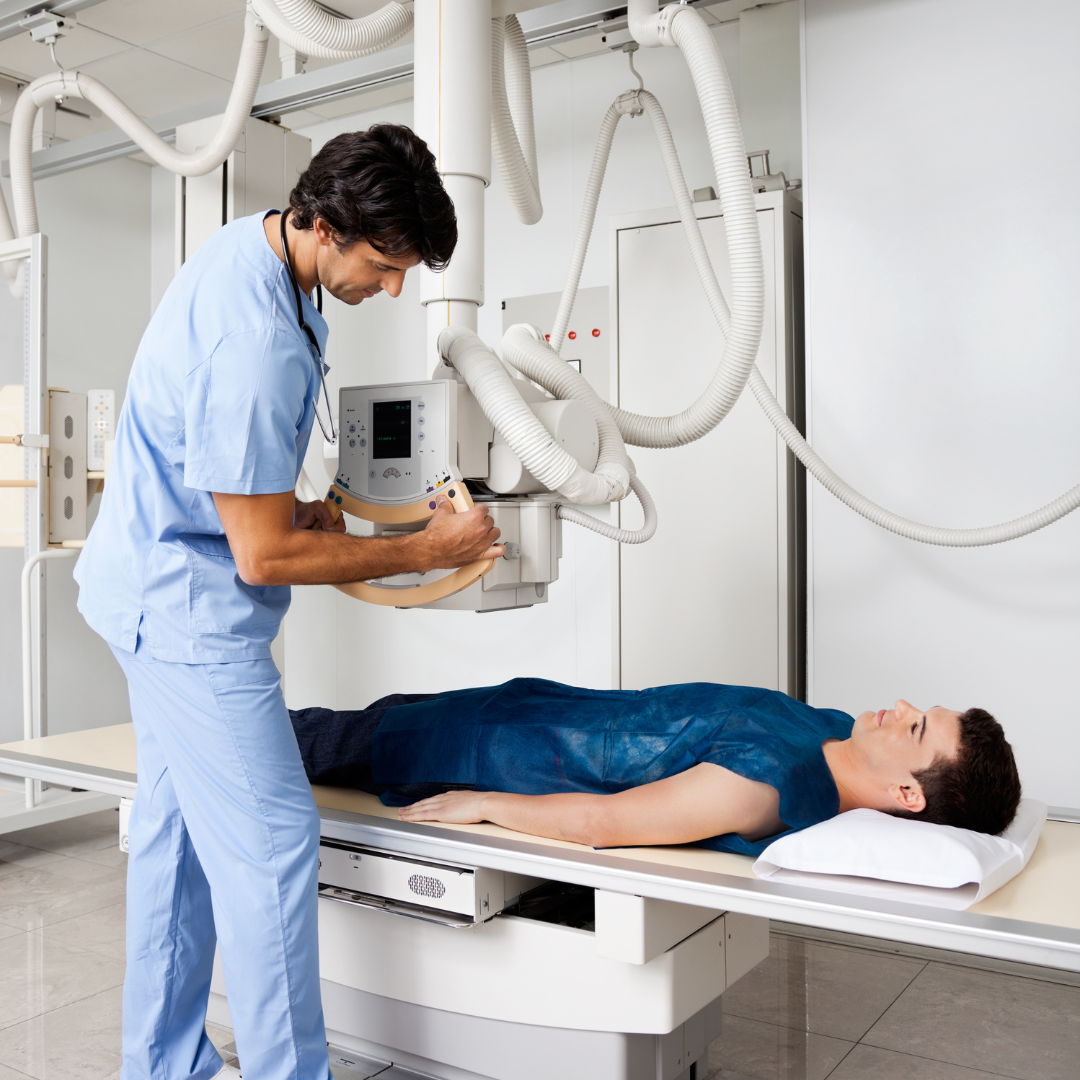
Medical imaging may be useful if you aren’t seeing steady improvement and require further investigation.
Hip pain versus back pain – how do I know which is which?
Research reports that hip pain can be mistaken for a nerve injury in the back. A study in 2019 examined the importance of assessing the back for pain in the extremities. They found that 71% of those with hip pain actually had a referral from the lower back. More studies need to be completed to confirm the accuracy of this percentage, but the anatomical location of the hip and the nerves that travel through the hip area is one reason alone to check the lower back.
What does lower back-related hip pain feel like?
These are some shared comments my clients have made when the back is causing hip pain:
Regular hip stretches don’t change the hip pain
Tingling, numbness, burning into the hip, groin, or thigh area
Weakness in one leg
Feeling “something is not right”
Radiating pain down the leg
Full movement in the hip with limited lower back movement
Some other symptoms that are not as strong indicators of back-related hip pain are:
Stiffness upon rising after sitting for long periods
The first steps after sitting causing soreness in the hip
These are just small tidbits of information that I’ve found over the years talking to hundreds of clients each year. If you feel that your back is causing hip pain, click “book now” to meet one of our skilled physiotherapists to help you find the source of your injury.
How do you relieve hip pain?
There are several ways that can help:
Stretching the lower back and hip
Strengthening the surrounding muscles of the hip
Manual therapy to improve range of motion where you are limited
Dry needling
Acupuncture
Find out more about how we can help you find relief with Dry Needling here!
Hip pain versus sciatica
Break Free Physiotherapy will help you get to the bottom of the issue and provide the tools to heal. Sometimes it is important to check the lower back first, followed by a screen of the hip. We use a methodological approach known as the McKenzie Method that helps us screen the lower back or any asymmetries that could be causing your hip pain. Certain nerves travel through your hip from your lower back. They travel between muscles and run down the back, side, and front of your groin and leg. Sometimes when a nerve is compressed in your back, it can cause symptoms to refer to the hip area and even cause restriction at the hip. After clearing the spine, we move to the hip to see if there is a joint or muscle related issue.
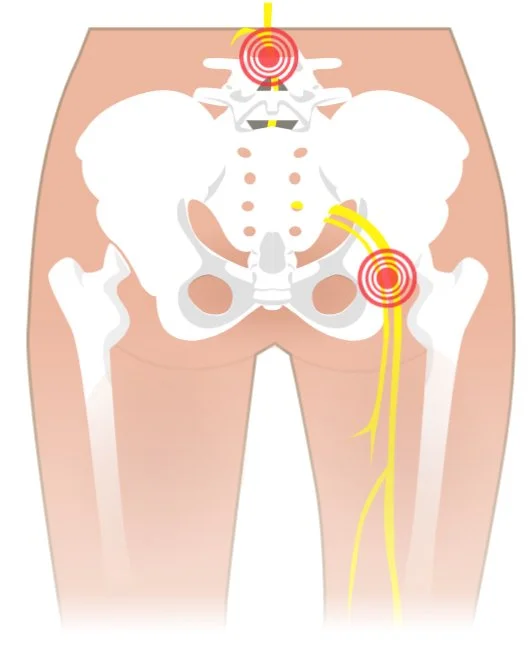
A depiction of pain travelling down a nerve from the lower back to the hip
What if things do not get better?
After 8 weeks of physiotherapy and proper clearance of the spine and hip for any chance of conservative improvement, we move to diagnostic imaging and referral to a specialist.
How do I tell if my hip pain is serious?
Red flags are signs that physiotherapists look out for to see if there is a more serious underlying issue. Some of these signs include:
A sudden onset of severe pain with trauma or a fall
Unable to weight bear on the leg or sudden inability to walk
Fevers, chills, night sweats, or feeling unwell
Significant bruising, swelling, redness, or warmth around the hip joint
A history of cancer with new pain around the hip, groin, or thigh area
Unremitting night pain with the inability to sleep
Loss of bowel or bladder control
What should I do if I have these symptoms?
Contact your family doctor or head to the emergency department. You will need additional testing to see if you have a condition that needs to be medically managed immediately. If you are in active care with your physiotherapist with these symptoms, you will be sent to a doctor with a written note to help advocate for you.
How do I know when to come to physiotherapy?
Are you confused? Lost? Stuck in limbo in the medical system? Our physiotherapists take a detailed history to listen to your story and concerns. We provide you with an approach that focuses on your goals and needs. We want you to get better in the shortest timeline and safest way possible. If you’re interested in getting better, call us to book an appointment today. Check out our team members to see who might be the best fit for you. Looking to learn more? Check out our pages on Low Back Pain and Hip Pain.
We want to see you move and thrive in the London, Ontario community. Looking forward to meeting you!

Corey Kim
Physiotherapist
Written by Corey Kim, MPT, Registered Physiotherapist & Co-owner of Break Free Physiotherapy and Wellness in London, Ontario. With over 10 years of clinical experience, Corey holds a Bachelor of Arts in Kinesiology and a Master of Physical Therapy from Western University. He is passionate about helping patients find pain relief through movement and believes in empowering people with knowledge of how the body heals. Read Corey's full bio →

Tarra D’hoine
Physiotherapist
Hi there! My name is Tarra. I completed my undergraduate degree in Hamilton at McMaster University obtaining an Honours Bachelor of Science in Kinesiology. I then returned to my hometown of London to complete my Master of Physical Therapy at Western University.
My approach to physiotherapy care is simple, it revolves entirely around you. I want to work with you to identify your goals and determine how physiotherapy can help you achieve them. Using a focus on education, self-management, and exercise-based rehabilitation, I aim to empower clients to reach their goals. Read Tarra’s full bio →
