

Sciatica: What It Is, What Causes It, and How Physiotherapy Finds the Source
By Corey Kim, MPT | Registered Physiotherapist | Published July 17, 2026

Tingling, numbness, and pain down the leg — does this sound like you? I've had a lot of clients recently who saw their family doctor after trying chiropractic, physiotherapy, and massage for months with no improvement. They're sent to a specialty clinic — in London, Ontario, we have Rapid Access Clinics through LHSC, where an advanced practice physiotherapist assesses whether they need the right type of physiotherapy, an injection, or surgery. They're often confused after waiting weeks or months to see a spine specialist, only to be sent back to a physiotherapist for more care. The question I hear most is, "Why am I being sent back to a physiotherapist again? I need an MRI, a CT scan, an injection, or surgery."
In other cases, clients are told to stop what they're doing completely and become afraid to get back to what they love. When they come into the clinic and find a movement that relieves the tingling, numbness, or pain, they often exclaim, "Why didn't I come here sooner?" There often isn't enough awareness of what can actually help with sciatica — so I've written this to help you figure out if physiotherapy could get you back to sport, activity, and life.
What Is Sciatica?
Sciatica is a symptom, not a diagnosis. It's like saying "I have a headache" — it tells us what you're feeling, not what's causing it. Sciatica is usually characterized as an ache, burning, tingling, pins and needles, numbness, or pain down the leg. Sometimes it's associated with weakness, and in some cases a sharp, electric-shock feeling.
The sciatic nerve is the longest nerve in the body — it runs from the lower back through the buttock and down the leg. Although the pain is often felt in the leg, the source is actually somewhere else. This matters because symptoms are often treated without understanding their source, which is why many people get temporary relief but not lasting change.
What Does Sciatica Feel Like?
A lot of my clients report different things — it's never quite the same from person to person. The most common complaint is pain that can radiate from the buttock, back of the thigh, calf, and sometimes into the foot. There's often an associated tightness along the leg that gets mistaken for a tight hamstring, calf, or IT band.
Other symptoms include burning, shooting, sharp, or deep aching sensations. Tingling and numbness are common, and symptoms are usually on one side. Many people say their leg doesn't feel like their own, or that they've lost some control or strength. In more severe presentations, people notice real weakness in certain muscles down the leg — which is what makes it hard to play sports, pick up a grandchild or a baby, go for hikes and long walks, or even run.
Ironically, many people experience leg pain without any back pain at all. It's a common myth that you have to have back pain if your symptoms are coming from your back. I have a lot of people convinced: "It can't be my back — it doesn't hurt. It must be a muscle in my leg." But when we dig into the history, there's often no evidence of a muscular strain, no slip or fall, and very little sign that they repetitively strained any of the muscles in their leg. In fact, there's often a history of back pain from earlier in their life — sometimes years ago, sometimes just months.
Some common triggers for sciatica symptoms include:
Sitting for long periods
Bending forward
Standing up from a chair
Sneezing or coughing
Bearing down
Lifting your child
Walking your dog
What Causes Sciatica?
There are several reasons sciatica can occur. If you don't need the full anatomical explanation, feel free to skip ahead to the next section. But if skipping around makes you anxious, here's the short version: there's an irritation of the nerve as it exits your spine, and that irritation causes the tingling, numbness, and pain you feel in your leg.
Your spine is made up of vertebrae — bones that protect your spinal cord — with discs sandwiched between each one. Your spinal cord is the information superhighway that carries signals from your brain to the rest of your body, giving you the ability to feel things through your skin and move your muscles. Between each vertebra, nerves branch off the spinal cord and exit through the spaces on either side. These become the peripheral nerves that travel to different parts of the body. When we're talking about sciatica, it's the nerves exiting the lower back and running down the leg that are affected.
One common cause of nerve compression is a disc injury. Discs are shock-absorbing structures — think of them like rubber tires — that protect your spine from vertical compression forces. At the center of each disc is a material called the nucleus pulposus, which helps create hydrostatic pressure, controls motion, and allows the disc to absorb vertical compression. Sometimes this material migrates outward, compressing the nerve root as it exits the spine. This is often where irritation begins, and it's the most common cause of sciatica, especially in younger to middle-aged patients. One reason this happens is repetitive strain on the disc. As we age, discs also change naturally, losing hydration and height over time.
This can show up on an MRI, but a herniation or bulge isn't automatically the cause of your sciatica. Many MRI findings are incidental, meaning they have no relation to how you're actually feeling — research has shown that plenty of people with disc herniations on imaging have no pain at all.
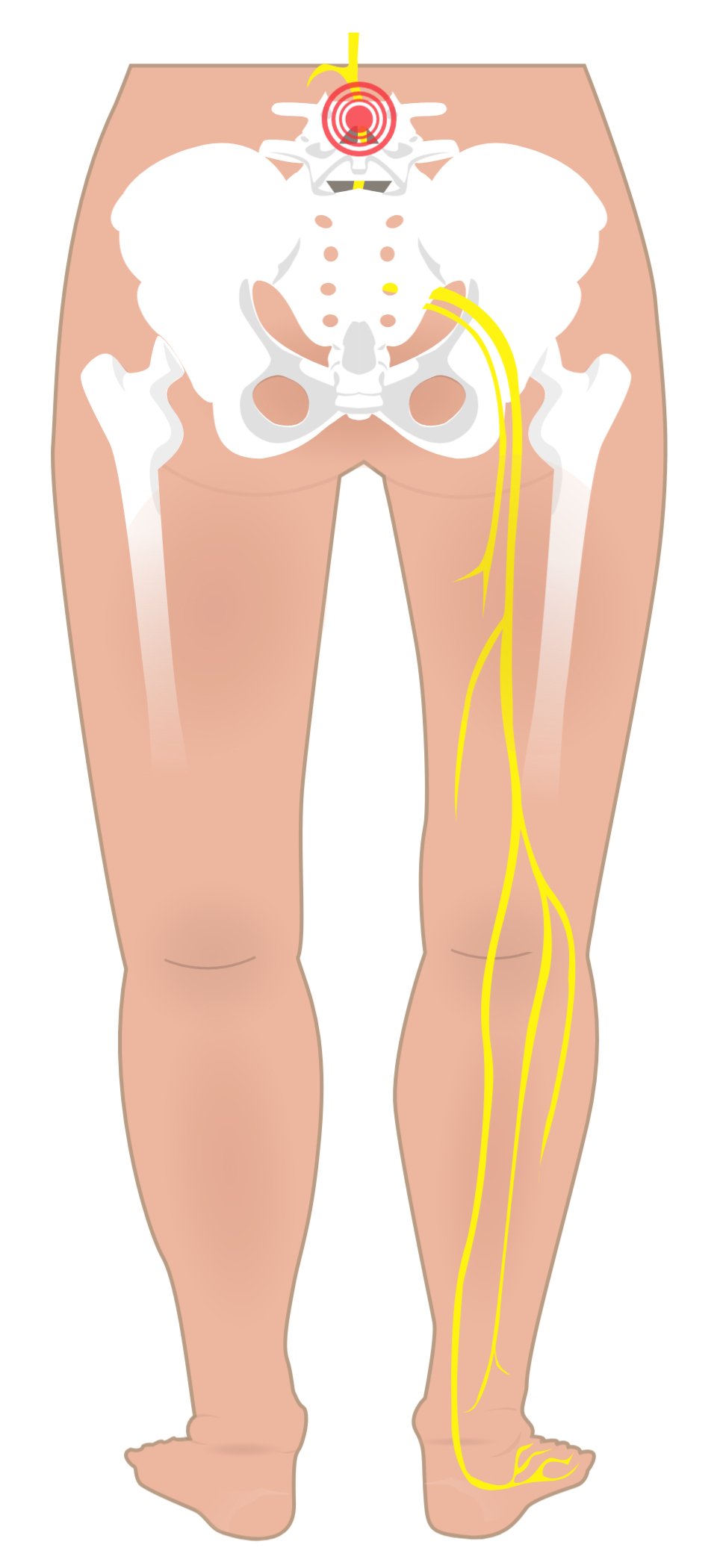
This image depicts nerves travelling down the leg form the spine.
The piriformis can also be involved. It's often an overstated buzzword in the healthcare industry, but this muscle — which runs from the front of your sacrum, at the base of your spine, to the top of your thighbone — does play a role in sciatica at times, since your sciatic nerve passes directly beneath it (and in some people, right through it) on its way down the leg. Tightness or spasm in the piriformis can compress or irritate the nerve at that point, causing tingling, numbness, and pain down the leg. Some people report a deep ache in the hip and find relief with stretches like the "figure four." That said, this alone rarely fixes sciatica completely — there's usually more than one area contributing to your symptoms.
Spinal stenosis happens when the central canal that houses your spinal cord, or the smaller spaces where nerve roots exit, becomes narrowed. This is more common in older adults and tends to be worse with standing or walking, and better with sitting.
Can your leg hurt when the real problem is your back? Absolutely — this is called referred pain, and it means the pain you're feeling may not even be sciatica, but pain referred from somewhere else entirely. It's crucial to find a physiotherapist who can tell the difference, so you know whether your issue is nerve-related, joint-related, or muscular.
This is why our clinicians at Break Free are trained in Mechanical Diagnosis and Therapy (MDT), also known as the McKenzie Method. It's a classification system that helps clinicians and clients understand where the source of an injury is actually coming from. MDT uses repeated movement to look for patterns, helping us classify your injury so your treatment matches your diagnosis.
Does Sciatica Go Away on Its Own?
Yes, for a lot of people it can — and this is something the research backs up. Studies following patients with disc-related sciatica have found that the body has a natural ability to shrink and reabsorb herniated disc material over time, without surgery. Interestingly, larger or more significant herniations tend to resolve more often than small ones, not less. It's a process driven by the body's own inflammatory and immune response, essentially clearing away the tissue that's causing irritation.
That said, "going away" and "resolving" aren't always the same thing. Pain can settle down while the underlying movement pattern that contributed to the problem in the first place is still there — which is part of why some people feel better for a while and then end up back in our clinic a year later with the same issue. There's also no fixed timeline. Some people notice real change within weeks, others take longer — it depends on your specific injury, since everyone's body responds differently.
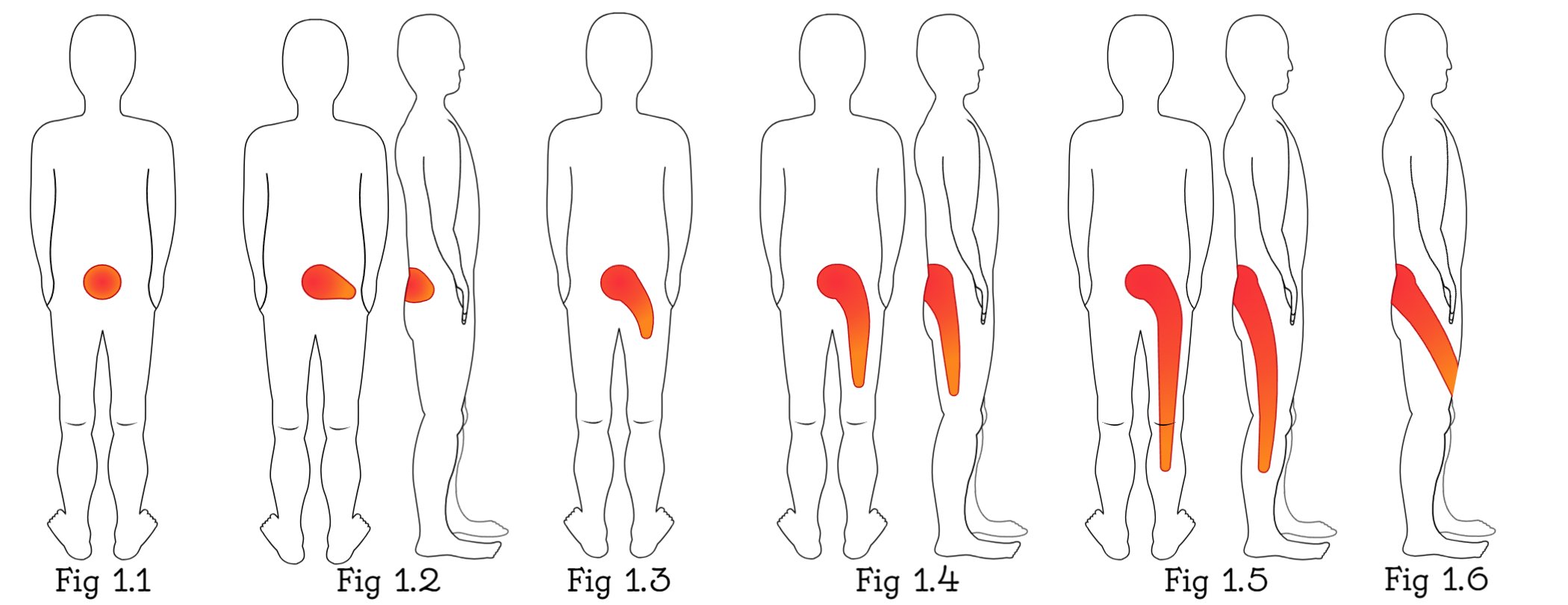
This image depicts the phenomenon of peripheralization (left to right) and centralization (right to left).
What we watch for clinically isn't just whether your pain is improving — it's how it's improving. If your leg symptoms are moving back toward your spine (centralizing) as we test certain movements, that's a strong sign your body is heading in the right direction. It helps us decide whether continuing to wait it out is reasonable, or whether it's time to get more targeted with your treatment.
Some signs your sciatica is improving:
Pain travels toward your lower back (centralization)
Strength increases in the affected limb
Range of motion increases in your lower back or affected leg
Sensation returns, and tingling or numbness starts to fade
The area of pain, tingling, or numbness shrinks
Some signs your sciatica is worsening:
Pain travels further down your leg, closer to your feet (peripheralization)
Strength decreases in your leg — you may feel clumsy or unable to lift it
Range of motion decreases in your lower back or affected leg
Numbness and tingling worsen in your leg
The area of pain, tingling, or numbness spreads
More serious signs to watch for:
If you notice a sudden onset of severe (10/10) leg pain with no warning, symptoms down both legs, or any changes in bowel or bladder control, it's best to head to the emergency room right away. If you're already in active care with your physiotherapist, they can write a note to help advocate for you.
How Does Physiotherapy Help Sciatica?
A physiotherapist will take a detailed history — asking specific questions about where it hurts, how long it's been going on, and what makes it better or worse — and will screen for any red flags.
We then complete a neurological screen to check for weakness, loss of reflexes, or increased neural tension in the leg. We also assess movement to see whether you've lost any range of motion — letting us know what's normal for your body helps us accurately gauge that loss.
At Break Free, we complete a repeated movement screen to see if your leg symptoms change with certain movements. We may try variations of a movement multiple times to see whether centralization or peripheralization occurs. We then have you test that movement at home for several days to see if things improve or worsen — either way, your response gives us information that helps us understand your pain.
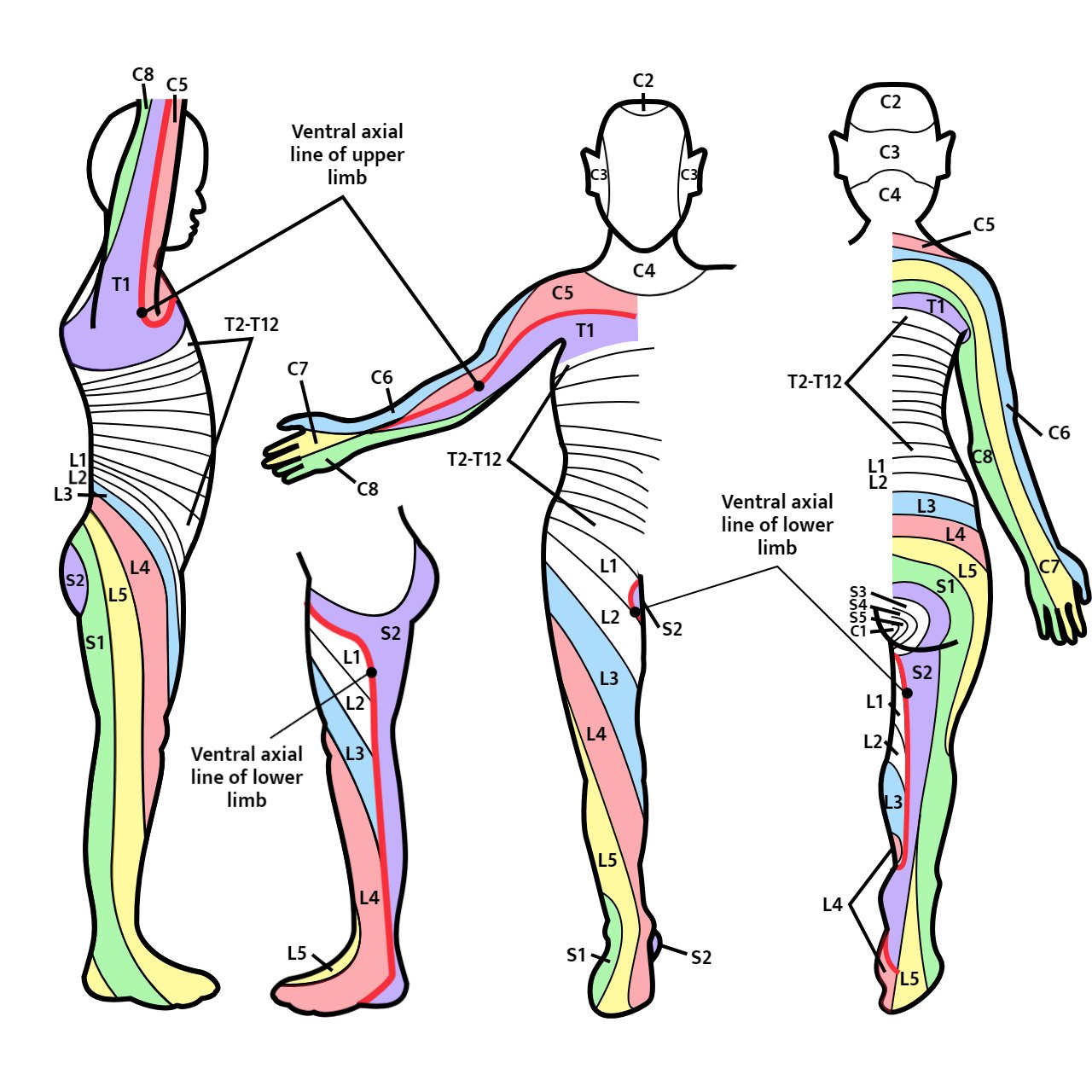
This image depicts dermatomes - these are the areas of skin that each spinal nerve root connects and provides information to and from.
Centralization matters because research shows it's linked to a more favourable outcome, meaning your chances of getting better are higher. Rather than just treating your symptoms, we aim to understand what's making you hurt so you can manage it yourself going forward. Our exercises are specific to you — instead of prescribing the same exercise to every patient, we carefully assess the effect of that exercise in clinic and give you the exact one your body needs. That's why the movements we ask you to do at home matter just as much as what we do in the clinic. We may even ask you to change how you're doing something at home — your posture when sitting, how you lift certain objects, or which movements to avoid for a period of time.
This matters to a lot of our clients because it helps you understand why you're doing the exercise, what effect it has, and how it will get you back to doing what you love.
If you're having trouble with the stretches, we may add manual therapy, mobilizations, or soft tissue work with our hands. If movement alone isn't enough, dry needling and acupuncture are also options to help calm down your nervous system's sensitivity.
What Does Sciatica Treatment Look Like at Break Free?
We're looking for a direction of movement, a position, or a particular stretch that changes your pain and helps us understand what's happening. We typically see clients for 4-6 visits, depending on the severity — it can be shorter or longer depending on how you present, what you respond to, and how long the injury has been around. Generally, the longer you've had the injury, the longer it may take to improve.
If you notice centralization at your first visit and stay consistent with your home movements and postural changes, many people notice meaningful improvement within their first two to three visits. At your next session, we fine-tune the movement to keep that trend of centralization going. As you improve, we space your visits out to confirm the change is stable and to help you strengthen any weak areas. This way, we know you're able to manage the problem on your own, without needing to rely on us long-term until a new injury comes up.
Does Physiotherapy Help Sciatica?
Yes! But it's important to talk about where physiotherapy actually makes a difference. It's important to look at the body as a whole, rather than in isolation. Rather than just treating the pain, tingling, or numbness in the leg with a modality like TENS or heat, we try to find the multiple factors that may be contributing to your leg pain — whether that's your low back, hip, or ankle and foot.
When Should You See a Physiotherapist for Sciatica?
The earlier you receive care, the faster the resolution tends to be. When pain has been around for a long time, your body adapts to it, which can make it harder to resolve.
If you're experiencing any of the following, these are red flags that require immediate medical attention: bladder or bowel changes, rapid or progressive leg weakness, symptoms in both legs, or saddle anaesthesia. This is especially concerning if these symptoms follow a significant trauma. It's a rare but serious condition known as cauda equina syndrome — as stated above, it's best to head to the emergency room if you're experiencing these symptoms.
Frequently Asked Questions
Is my sciatica permanent, or will it heal?
This is the question we hear the most, and it's a fair one to ask. The honest answer is that we can't promise a timeline on day one — but we can tell you what we're watching for. When we do our assessment, we're looking for something called centralization: does your leg pain move back toward your spine as we test certain movements and positions? If it does, that's a genuinely good sign. Research on this phenomenon has consistently shown that patients who centralize tend to have a better prognosis than those who don't, even when the leg pain is significant to start. So rather than guessing, we use your response to movement in the first session or two to give you a realistic picture of what to expect — not a generic answer, but one based on how your body is actually responding.
Can sciatica be cured?
Sciatica itself isn't really the thing we're curing — it's the symptom. What we're treating is the source: a disc, a joint, a nerve that's irritated. In many cases, especially when we identify a clear direction of movement that reduces your symptoms, people get back to full function and stay there. The piece that matters long-term is addressing the underlying movement pattern, not just chasing pain relief, because that's what tends to prevent it from coming back.
How long does sciatica typically last?
It depends on the cause and how your body responds to treatment, so we're cautious about giving a blanket number. Some people feel meaningful improvement within their first few visits once we identify what direction of movement helps. Others, particularly with more chronic or complex presentations, take longer. What we can tell you early on is whether your symptoms are trending in the right direction, which is often a better indicator than any fixed timeline.
Does walking help or hurt sciatica?
It depends on what's driving your symptoms, which is part of why we don't recommend generic advice for this. For some presentations, walking is genuinely helpful and encourages centralization. For others — particularly if spinal stenosis is contributing — walking or standing for too long can aggravate things. This is exactly the kind of question your assessment answers directly, rather than us guessing at it for you.
Ready to Get Some Relief?
It's tough to have constant pain and not find a solution — moving from clinician to clinician without seeing real change. It's important to have someone look at your injury with fresh eyes and offer a simpler approach that can evolve in complexity as your understanding grows. I'd encourage you to read more about lower back pain, where you'll find plenty of free resources. If you need help, click here to book with one of our skilled physiotherapists today.
References
Chiu CC, Chuang TY, Chang KH, Wu CH, Lin PW, Hsu WY. The probability of spontaneous regression of lumbar herniated disc: a systematic review. Clinical Rehabilitation. 2015;29(2):184-195.
Tsang K, Rashed S, et al. Systematic review and meta-analysis of predictive factors for spontaneous regression in lumbar disc herniation. Journal of Neurosurgery: Spine. 2023;39(4):471-478.
Werneke M, Hart DL. Centralization phenomenon as a prognostic factor for chronic low back pain and disability. Spine. 2001;26(7):758-765.
Long A, Donelson R, Fung T. Does it matter which exercise? A randomized clinical trial of exercise for low back pain. Spine. 2004;29(23):2593-2602.
Brinjikji W, Luetmer PH, Comstock B, et al. Systematic literature review of imaging features of spinal degeneration in asymptomatic populations. American Journal of Neuroradiology. 2015;36(4):811-816.

Corey Kim
Physiotherapist
Written by Corey Kim, MPT, Registered Physiotherapist & Co-owner of Break Free Physiotherapy and Wellness in London, Ontario. With over 10 years of clinical experience, Corey holds a Bachelor of Arts in Kinesiology and a Master of Physical Therapy from Western University. He is passionate about helping patients find pain relief through movement and believes in empowering people with knowledge of how the body heals. Read Corey's full bio →
