
TMJ Pain and Headaches: How Physiotherapy Addresses Both at the Same Time
By Corey Kim, MPT | Registered Physiotherapist | Published June 17, 2026

Hi readers,
If you've opened this blog, you're interested in how headaches and jaw pain are connected. To help you understand what that connection is, let me share a personal experience that happened to me this past weekend.
At my sister's wedding shower, I was picking something up under a tree. As I stood up, I felt a searing pain across the right side of my skull — my head had scraped an overhanging branch. There was blood, and my head was sore for the rest of the day.
The following day, I had a headache that worsened with chewing on that side. What I realized later is that one of the muscles that helps me chew had been injured, and that was creating my headache.
As I reflected on this experience as a physiotherapist who treats temporomandibular disorders, I was reminded of just how much the muscles that help you chew can contribute to headaches — and how easy it is to miss the connection.
What Is TMJ Disorder?
TMJ disorder, also known as temporomandibular disorder (TMD), is a condition involving limited or painful motion of the jaw. Your temporomandibular joint is a hinge that allows you to open, close, and shift your jaw left and right. The muscles that attach to your jaw and skull make it possible to bite, chew, talk, and yawn.
What often happens is that muscular tension builds up within these muscles over time. This can be driven by habits like clenching, forward head posture, and grinding your teeth at night (bruxism). Over time, habits like these can cause a disc within the TMJ to displace forward, creating a clicking sensation on one or both sides. The result can be significant pain, limited jaw opening, neck pain, and headaches.

(Depicted Blue)
Why Does TMJ Cause Headaches?
Several muscles attach to both your jaw and your head — the temporalis, masseter, and pterygoids. These muscles help close the jaw and tend to become tense when you spend long periods in forward head posture. As they fatigue and tighten, your body compensates by recruiting other muscles in your neck that were never intended for chewing and swallowing.
The suboccipital muscles — small postural muscles at the base of your skull — become overloaded as they work to stabilize your head in a forward position. Over time, this creates tension that refers pain upward into the head, contributing to headaches. Think of an ice cream headache — the cold is in your mouth but you feel it in your head.
The challenge is that there are over 150 recognized causes of headaches according to the International Headache Society, which makes misdiagnosis very common. But there are some specific signs that can help you figure out whether your headache is being driven by your jaw — and I'll cover those next.
What Does TMD Feel Like?
People describe their jaw problems to me in a lot of different ways. You might notice:
Clicking or popping in the jaw
Locking or difficulty opening your mouth fully
Facial tension or tightness around the temples
Pain with chewing, yawning, or talking
Morning headaches
Ear pain or a feeling of fullness in the ear
Here are some signs that your jaw may specifically be contributing to your headaches:
Your pain is located around your temples or behind your eyes
You wake up with a headache after a night of clenching or grinding
Your headache changes when you move your jaw — chewing, yawning, or opening wide
You notice clicking in your jaw when you eat or open your mouth fully
Traditional pain medications don't seem to make much of a difference
Sitting at a computer or looking at your phone for extended periods makes your headaches worse
Your headaches started after a recent dental procedure
You also have neck pain alongside your jaw symptoms
When your stress levels rise, your headaches tend to follow
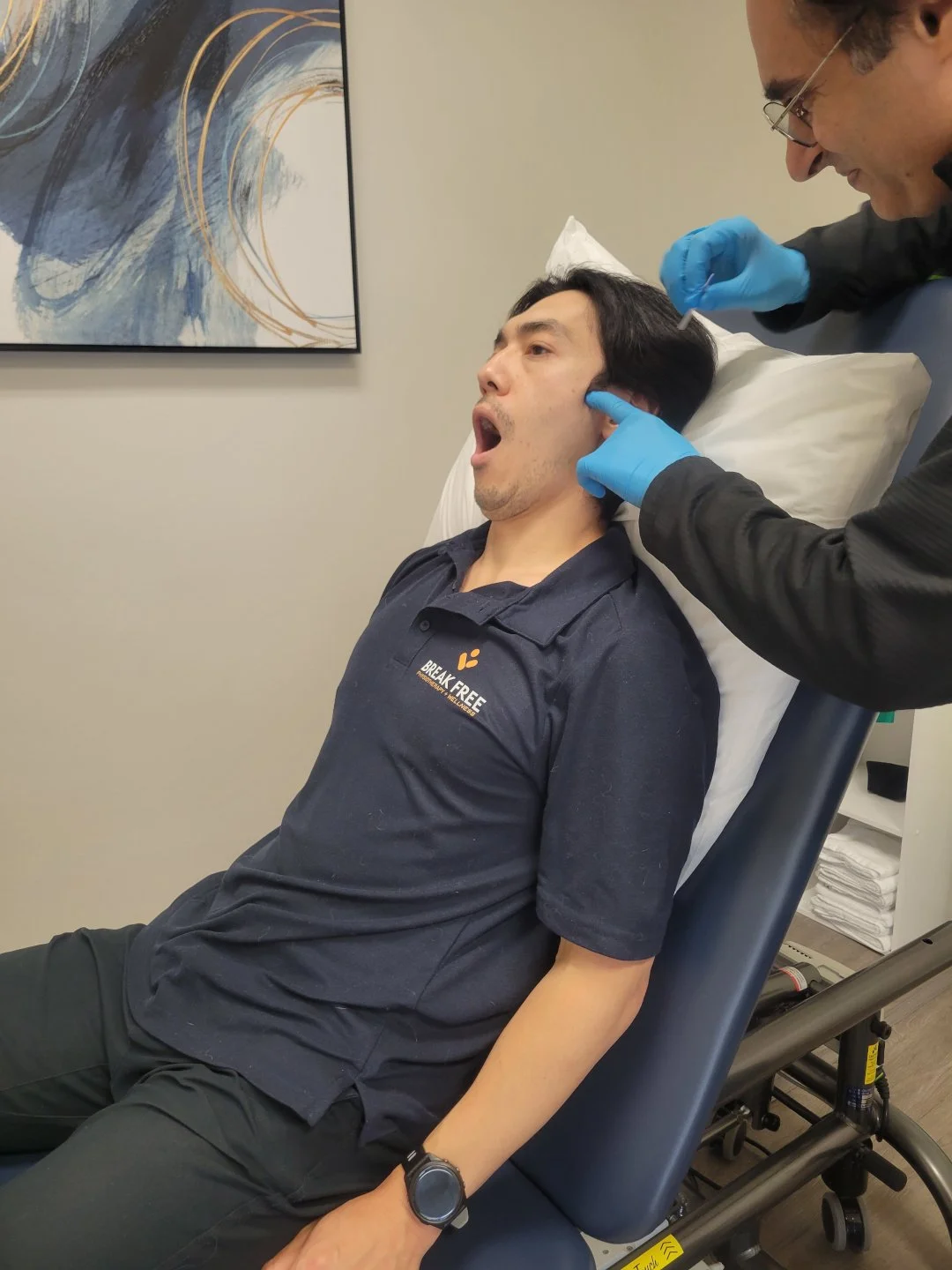
Acupuncture is one of the common modalities we use to treat TMJ issues.
How Does Physiotherapy Help TMJ and Headaches?
Your physiotherapist at Break Free will start by getting a thorough understanding of your jaw problem. This means taking a detailed history, reviewing your medical background, and understanding your goals and what you're experiencing day to day.
From there, your physiotherapist will complete a hands-on examination. This includes an intraoral examination of the muscles that may be tight and the joints that may be restricted or hypermobile. Your neck, upper back, and shoulders will also be assessed to determine whether they are contributing to your symptoms. Your resting posture will be evaluated, and recommendations will be made around your sitting set-up at work and home to make sure you are not prolonging your injury through poor mechanics.
Once your physiotherapist understands the full picture, they will explain the reasons for your injury in plain language and then get to work. Treatment may include intraoral massage, dry needling, acupuncture, and manual therapy to relieve jaw pain and reduce headache frequency and intensity.
At Break Free, we always give our clients the tools to heal. That means you will leave every appointment with exercises to continue your progress at home. In-person treatment provides a boost, but without consistent home exercise, progress tends to be slow and temporary. We are in the business of keeping you feeling better long term — and that requires building your understanding of your injury, not just treating the symptoms.
What Does TMJ Treatment Look Like at Break Free?
Our approach is built around teaching you about your injury so you understand how to help yourself and stay better over time. Our job as physiotherapists is to guide your healing using movement diagnostics — figuring out what to avoid and what to do more of — so that you gain back control over your pain rather than relying on us indefinitely.
For most people, we recommend between 4 and 6 visits, though this varies by person and can be shorter or longer. After your first visit, if you receive dry needling, acupuncture, or manual therapy, you should notice a decrease in jaw tension, a reduction in the intensity of your headache and jaw pain, and an improvement in how wide you can open your mouth.
Over the following weeks, with consistent exercises and posture changes, you should see gradual improvement session after session. As your pain decreases and your understanding of your injury increases, we will begin spacing out your visits. This gives the changes in your jaw time to stick without our support, and gives your muscles time to build the strength needed to stay that way.
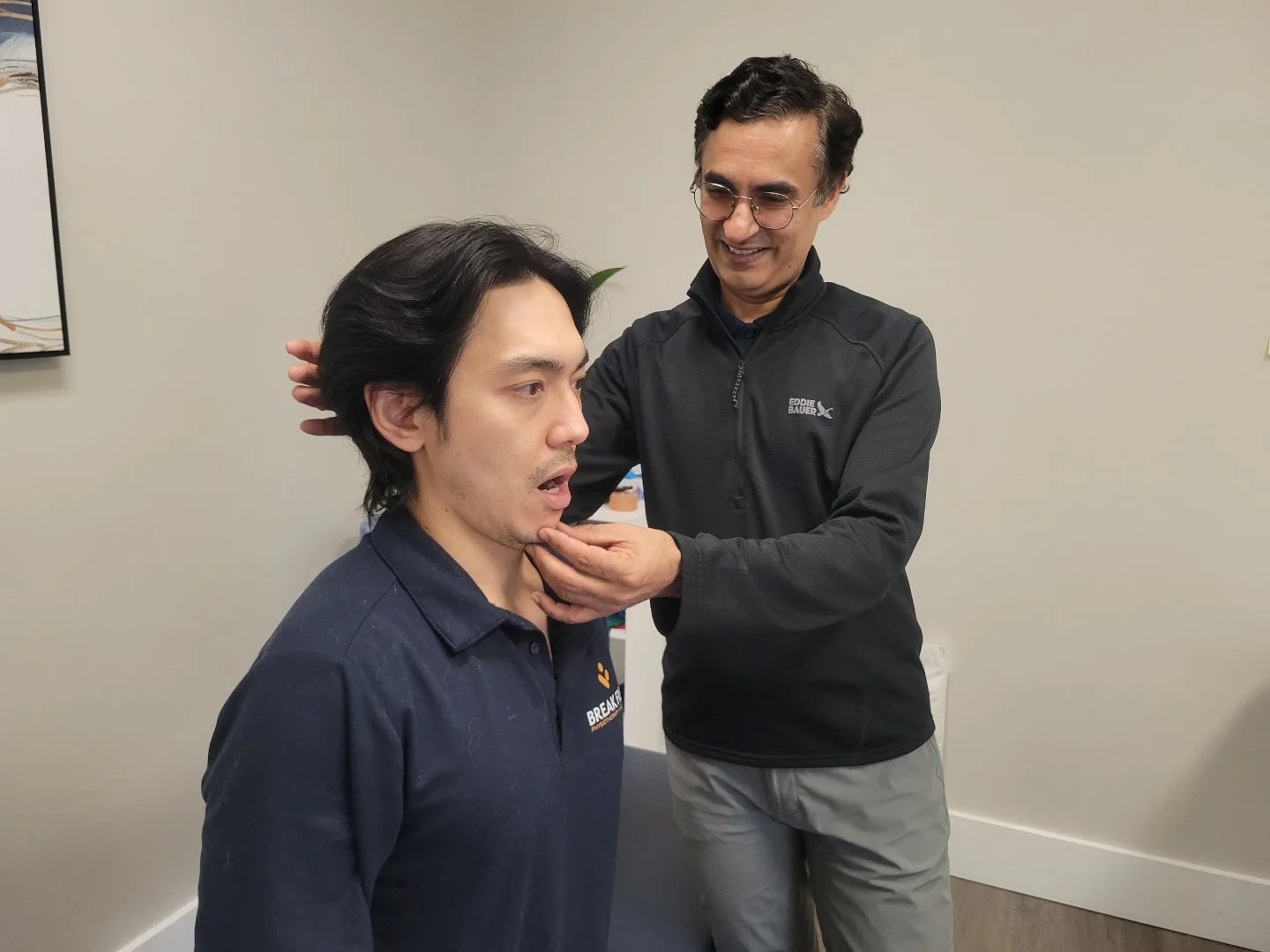
Abhi performing manual therapy on the jaw to help provide relief from jaw tension.
Does Physiotherapy Help TMJ?
Yes — and here is why it works so well. Physiotherapists at Break Free are trained to treat TMJ pain by seeing the body as a whole, not as separate independent parts. Your neck, upper back, and shoulders all play a role in your jaw pain and headaches. Treating the jaw in isolation is rarely the complete solution. Looking at the full system — and building your understanding of how it all connects — is what helps you find relief sooner and stay better longer.
When Should You See a Physiotherapist for Jaw Pain?
Whether you have had chronic jaw pain, clicking, and headaches on and off for years, or whether your symptoms just started recently, the right time to book an assessment is now. Coming in earlier tends to lead to faster resolution — injuries that have been present for longer generally take longer to resolve than more acute ones.
That said, there are some warning signs that indicate a more serious problem requiring emergency attention:
Thunderclap onset — your pain spikes from 0 to 10 in under 60 seconds
Confusion, weakness, numbness, vision loss, or slurred speech
Fever, chills, stiff neck, or unexplained weight loss
Sudden onset of headaches after age 50 with no previous history
It is also worth working with your dentist alongside your physiotherapy care. Many of my clients have been wearing the same night guard for two or more years — and dental bites change over time as a normal part of aging. If your guard no longer fits well, it may not be doing its job. Consult with your dentist if you are unsure whether your current guard still suits your bite.
Ready to Get Some Relief?
Does any of this sound familiar? Maybe you have been putting it off for a while. We understand — life gets busy. But with a little guidance from us, you can start to understand your injury, feel better, and learn how to manage it long term.
[Learn more about TMJ physiotherapy at Break Free →]
[Book Your Assessment →]

Corey Kim
Physiotherapist
Written by Corey Kim, MPT, Registered Physiotherapist & Co-owner of Break Free Physiotherapy and Wellness in London, Ontario. With over 10 years of clinical experience, Corey holds a Bachelor of Arts in Kinesiology and a Master of Physical Therapy from Western University. He is passionate about helping patients find pain relief through movement and believes in empowering people with knowledge of how the body heals. Read Corey's full bio →
