
Does this sound familiar?
My knee hurts going up or down stairs
I hear clicking or popping when I move it
My knee aches after I run, even short distances
It swells up after I've been active
It feels like it might give out on me
It hurts to squat or kneel down
Knee Pain Physiotherapy in London Ontario

The knee can be a crucial joint to live your life. From bending down to pick something off the floor to running your personal best race time - it takes a lot of pressure from day-to-day and recreational activities. It's frustrating to have knee pain when you have a busy schedule and you need to figure out why your knee is hurting. Our clinic can help you find out the reason why it hurts to do things, by narrowing down what movements, strength training, or potential imaging you may need to get the answer you're looking for.
Conditions We Treat
Here are some conditions we treat at Break Free Physiotherapy:
Patellofemoral pain syndrome
IT band syndrome
Meniscus injuries
ACL, MCL, and LCL injuries (non-surgical and post-surgical)
Knee osteoarthritis
Patellar tendinopathy ("jumper's knee")
Post-surgical knee rehabilitation
Running-related knee pain
Knee pain referred from the lower back
Our Approach to Knee Pain
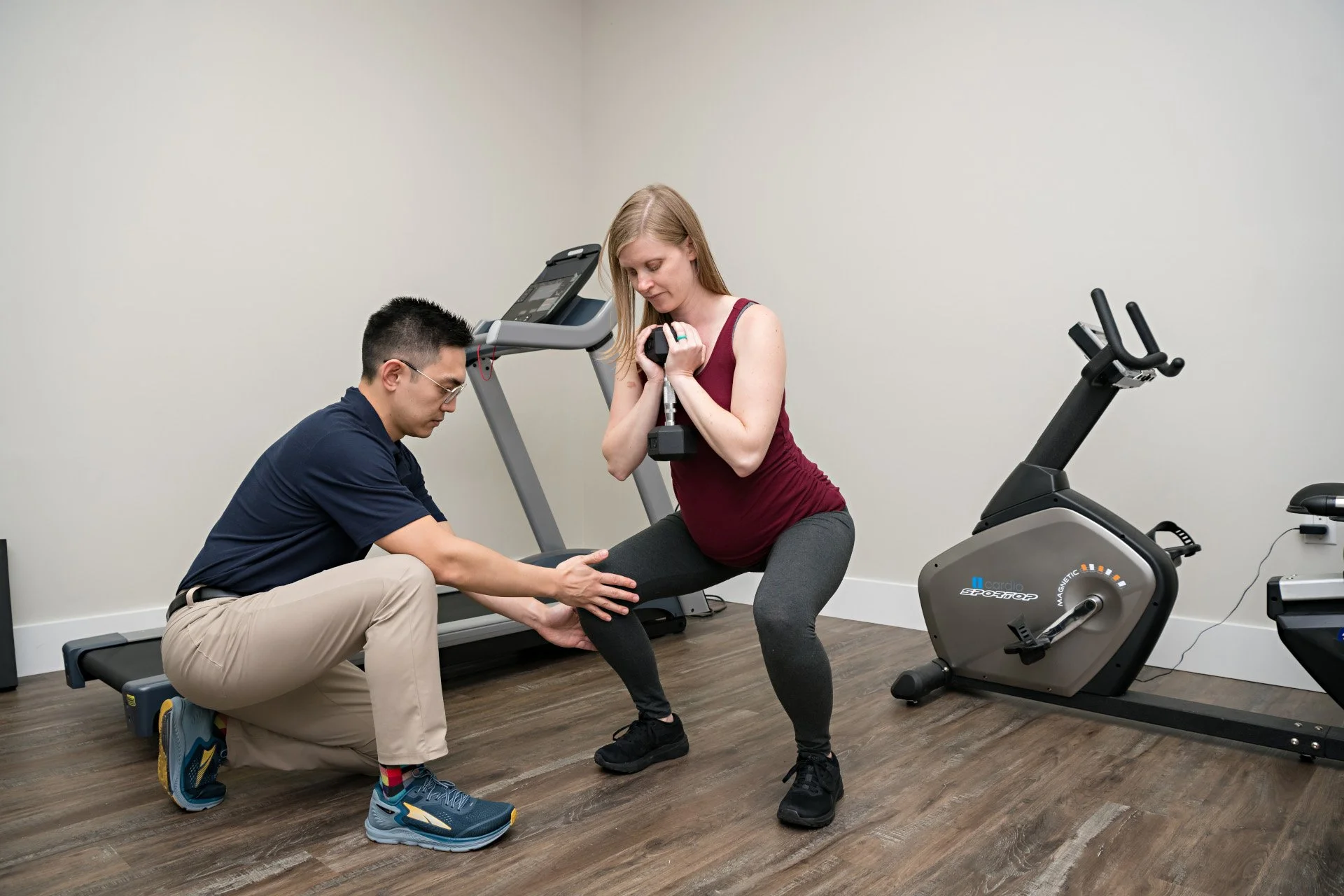
We look at injuries with an investigative lens, rather than chasing pain by treating the symptoms alone. Once we better understand the reason for your knee pain, we can give you the understanding on how to manage it yourself long term rather than solely relying on the clinician.
We will often do a spinal screen to see if your symptoms are related to your mid and lower back. Sometimes nerves can conduct differently if your spine is not moving well, which can cause altered mechanics of the knee. We also look at your joints above and below and complete a comprehensive assessment to ensure we don't miss anything.
Mechanical Diagnosis and Therapy (MDT), also known as the McKenzie Method, is the framework we use to classify your knee pain. We'll move your knee — and where relevant, your back — in specific directions and repeat those movements to look for patterns in how your symptoms respond. This tells us not just what to fix, but the fastest way to fix it, so instead of giving you a generic list of knee exercises, we give you exercises specific to what your body actually needs.

What to Expect at Your First Visit
We take a detailed history to help us understand when your injury started, what makes it worse or better, the location of your pain, and many other questions so we can narrow in on your problem. We then use our hands to confirm our hypothesis and check your range of motion, strength, and complete special tests to determine if our suspicions are correct. Of course, with your permission, we'll screen the lower back to see if there is any correlation.
Does Physiotherapy Help Knee Pain?
Yes! It is the first line of defence for most knee injuries - whether it's chronic or recent, we are here to help. We can offer suggestions such as the use of a gait aid (cane, crutch), a brace, and even give suggestions on how to modify activity to decrease your pain. This will ultimately create less pain and inflammation and get you back to what you were doing in a timely manner.
Frequently Asked Questions
How long does it take for knee pain to improve with physiotherapy?
It depends on your injury. A more recent injury when you are younger has a shorter timeframe for healing. These types of conditions you'll see changes within weeks if you initially decrease the irritation to your knee. The more complex cases — with multiple other injuries, older age, and the longer you've had the injury — can delay healing and take more time to see results. If the pain is originating from your back, typically we see a quicker turnaround of healing times.
Do I need imaging or a referral before starting?
No! It's a myth that you need imaging for your physiotherapist to find out what is going on in your knee. There are special tests your physio can complete and questions to clarify what could be going on. If you have imaging or a referral, please still bring it in and we'd be happy to discuss it with you.
Can physiotherapy help knee osteoarthritis without surgery?
Yes. Best practices for osteoarthritis are focused around strength and mobility, which physiotherapists are skilled at prescribing in the presence of pain and limited range of motion. The physiotherapist can provide specific stretches, mobilizations, or exercises to help you get back into action.
Why does my knee still hurt after trying exercises I found online?
Did anyone check your back? Did they assess exactly which muscles were weak, or just hand you a generic list of knee exercises? You may need a real assessment to understand what's actually happening in your knee.
Struggling with Knee Pain?
Look no further — if you need help finding out what's going on, we want to help you! See one of our skilled physiotherapists trained in MDT to help provide you the tools you need to heal.